Direct Overview: What Makes South Indian Murukku Special?
South Indian Murukku is a timeless, savoury spiral snack crafted from processed raw rice flour blended with roasted urad dal (black gram) or roasted gram (pottukadalai) flour, seasoned with fragrant asafoetida (perungayam), cumin seeds (jeeragam), or sesame seeds (ellu), and fried to crisp perfection. Unlike generic commercial crisps made with palm oil and artificial flavor enhancers, authentic South Indian Murukku relies on the thermodynamic purity of 100% cold-pressed groundnut oil and precise dough moisture to achieve its signature shatter-crisp crunch without oily heaviness.
Across the four southern states of India, no celebration, afternoon tea time, or temple festival is complete without the resonant, rhythmic crunch of freshly fried Murukku. Derived from the ancient Tamil word "murukku" (முறுக்கு) — which literally translates to "twisted" or "coiled" — this snack is a testament to centuries of culinary geometry, food preservation science, and grain mastery.
Here at RajaGopal Sweet Stall (Kumari Snacks) on Asambu Road in Vadasery, Nagercoil, our master snack crafters have been rolling, pressing, and frying traditional savouries since 1965. For over six decades, we have maintained the strict artisanal codes of South Tamil Nadu snacking: pristine stone-ground flours, pure cow butter for dough tenderness, aromatic whole spices, and smoking-hot cauldrons of cold-pressed groundnut oil.
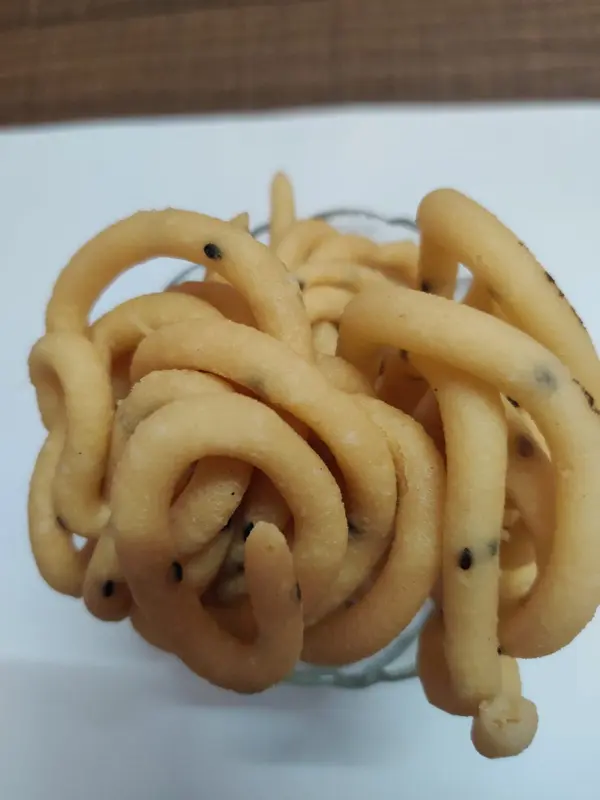
Crispy, golden South Indian Murukku: Handcrafted spirals with cumin and sesame seeds.
The Great Varieties of South Indian Murukku
While outsiders often use the word "murukku" as an umbrella term, connoisseurs know that each distinct variety possesses its own proprietary flour geometry, moisture ratio, nozzle disc, and crunch profile. Below are the five essential types that form the cornerstone of South Indian savoury traditions:
1. Kai Murukku (The Hand-Twisted Queen)
Kai Murukku is widely regarded as the ultimate test of a South Indian snack master's dexterity. Unlike extruded snacks, Kai Murukku uses zero presses or mechanical dies. The cook pinches a small cylinder of tender rice and urad dal dough between the thumb, index, and middle fingers, twisting it in rhythmic, continuous revolutions across a greased banana leaf or white cloth into concentric concentric rings.
- Texture: Incredibly dense, robust snap with a glass-like sheen.
- Flavor: Pronounced roasted urad dal warmth, buttery undertones, and toasted white sesame seeds.
- Cultural Significance: Essential in wedding 'Seer Bakshanam' gift baskets, baby showers (Seemantham), and grand temple offerings across Tamil Nadu.
2. Thenkuzhal Murukku (The Tubular Festive Classic)
Translating poetically to "honey tube", Thenkuzhal Murukku is extruded through a cylindrical brass press fitted with a disc containing three smooth, round perforations. The dough coils effortlessly into loose, airy, hollow nests that fry rapidly in hot oil.
- Texture: Light, airy, brittle crunch that yields pleasantly without straining the teeth.
- Flavor: Delicate cumin seed (jeera) aroma accented by sharp Hing (asafoetida).
- Occasion: The indispensable centrepiece of Gokulashtami (Krishna Jayanthi) and Diwali morning breakfast trays.
3. Mullu Murukku / Magizhampoo Murukku (The Spiky Star)
Extruded through a star-shaped nozzle (mullu means 'thorn' in Tamil), this variety has ridges and serrated edges that expand dramatically when dropped into boiling oil. The multi-faceted surface area ensures ultra-crispy edges that brown slightly faster than the core.
- Texture: Intensely sharp, crackling crunch with serrated ridges that hold spice dustings.
- Flour Base: Often incorporates a portion of roasted Bengal gram (pottukadalai) flour alongside urad dal for an extra brittle snap.
4. Butter Murukku / Vennai Murukku (The Melt-in-the-Mouth Treasure)
Where standard murukku aims for a resounding, hearty snap, Butter Murukku aims for velvet tenderness. Generous quantities of fresh churned white butter (vennai) are creamed into the flour blend before adding moisture. It is usually pressed into short, bite-sized wavy strips rather than large concentric rings.
- Texture: Feather-light, powdery melt on the tongue that dissolves within seconds of chewing.
- Popularity: A universal favourite among young children and seniors who prefer gentler savouries over hard crisps.
5. Ring Murukku / Chegodilu
Popular across the border corridors of Andhra Pradesh and northern Tamil Nadu, Ring Murukku is prepared by boiling rice flour into a soft dough (kali), hand-rolling it into thin noodles, and joining the ends into circular golden rings before deep frying.
| Murukku Variety | Flour Formulation | Shaping Method | Crunch Profile | Signature Spices |
|---|---|---|---|---|
| Kai Murukku | Raw Rice Flour + Roasted Urad Dal (4:1) | 100% Hand-twisted spirals | Dense, glass-hard structural snap | White sesame, Asafoetida, Butter |
| Thenkuzhal Murukku | Rice Flour + Light Urad Dal (5:1) | 3-hole round brass plate extrusion | Light, tubular, airy hollow crunch | Whole Cumin (Jeera), Asafoetida |
| Mullu Murukku | Rice Flour + Roasted Gram Flour (Pottukadalai) | Star-shaped serrated nozzle | Sharp, spiky, crackling ridges | Ajwain (Omam) / Cumin seeds |
| Butter Murukku | Rice Flour + Gram Flour + High Ghee/Butter | Flat ribbon or short star strips | Tender melt-in-mouth dissolve | Pure cow butter, Cumin, Mild salt |
The Chemistry of the Perfect Crunch: Flour Ratios & Moisture
Every grandmother and sweet stall master knows that great Murukku is an exact science. The secret to extraordinary crunch lies in three chemical milestones:
- The Moisture Level of Raw Rice Flour: Using wet-ground, shade-dried raw rice flour (processed from aged short-grain paddy) ensures that starches gelatinize instantaneously upon contacting boiling oil, creating thousands of microscopic steam bubbles that yield a brittle cell structure.
- The Roasting of Urad Dal: Black gram dal must never be raw when milled, nor should it turn brown. It must be dry-roasted on gentle cast-iron heat until fragrant and warm to the touch, then ground into a silk-fine powder. This releases nutty pyrazines that give South Indian murukku its unmistakable bakery aroma.
- Fat Emulsification (Moyan): Adding soft butter or smoking-hot groundnut oil into the dry flour before adding water coats the starch granules, preventing excessive gluten development and ensuring the murukku remains crisp rather than chewy.
Why Cold-Pressed Groundnut Oil Makes the Decisive Difference
In modern mass production, commercial snack factories have almost entirely switched to cheap refined palm oil or hydrogenated vegetable fats. While this lowers costs, it ruins the culinary soul of the snack:
- Zero Palate Coating: Palm oil has a high melting point, leaving an unpleasant waxy grease slick on the roof of your mouth. In contrast, pure cold-pressed groundnut oil (marachekku kadala ennai) has a clean, natural melting profile that feels remarkably dry to the fingers and light on the digestive tract.
- Nutty Resonance: Groundnut oil naturally complements the toasted aromas of urad dal, cumin, and sesame seeds, forming an integrated symphony of South Indian flavour.
- Oxidative Stability: Rich in natural monounsaturated fatty acids (MUFA) and natural vitamin E tocopherols, cold-pressed groundnut oil resists rancidity, keeping Murukku crisp and aromatic for over 45 days.
Troubleshooting Murukku: Common Mistakes & Fixes
Master Baker's Troubleshooting Checklist
1. Why did my Murukku turn rock hard? You added too much urad dal flour or insufficient butter/oil fat to the dough. Keep the rice-to-urad ratio at minimum 4:1, and ensure 1 to 2 tablespoons of soft butter per 2 cups of flour.
2. Why did my Murukku break into pieces while pressing? The dough is too dry or stiff. Add a sprinkle of water and knead lightly until pliable and smooth like soft clay.
3. Why does my Murukku absorb too much oil and feel soggy? The dough was too wet, or your oil temperature dropped below 175°C (350°F). Ensure oil is moderately hot before dropping spirals.
4. How do I know when Murukku is fully fried? Watch the vigorous boiling bubbles (the "shhh" sound). When the steam moisture has evaporated, the vigorous bubbling subsides almost completely and the murukku sinks gently to the bottom of the kadai. Remove immediately onto stainless steel perforated skimmers.
The 4 PM Tea Ritual: Perfect Beverage Pairings
In Nagercoil and Kanyakumari, evening tiffin is a sacrosanct cultural institution. As 4:00 PM approaches, steam rises from brass davarah-tumblers of piping hot Kumbakonam degree filter coffee. The slight bitterness of dark roasted chicory coffee cuts cleanly through the savoury richness of Murukku, creating an unforgettable balance of crunch and aroma.
For rainy monsoon evenings, pair your Murukku alongside hot Vadasery onion cashew pakoda or spicy ginger-coriander herbal tea (Sukku Malli Tea) for an authentic Tamil culinary feast.
Explore More Authentic Nagercoil Savouries
Complete your South Indian tea-time table with our collection of traditional, preservative-free snacks:
- Authentic Nendran Banana Chips: Sliced ultra-thin from Western Ghats raw green plantains and fried in cold-pressed groundnut oil.
- Famous Vadasery Pakoda: Legendary onion-cashew savoury prepared fresh at 4 PM daily.
- Traditional Omapodi: Melt-in-the-mouth golden ribbons infused with carom seed (omam) digestive extract.
- Top 5 South Indian Crispy Snacks Guide: The comprehensive review of Tamil Nadu's finest savouries.
- Snack Storage & Shelf Life Guide: Tips to keep your festive snacks fresh and crunchy for weeks.
Crave the Authentic Crunch of Fresh Handcrafted Murukku?
At RajaGopal Sweet Stall in Vadasery, Nagercoil, our master snack makers press and fry fresh batches of artisanal Murukku daily in pure cold-pressed groundnut oil. Shipped in multi-layer vacuum sealed packs to preserve that pristine kitchen-fresh snap.