Direct Overview: The Secret to Crispy South Indian Onion Pakoda
The secret to achieving ultra-crispy, non-soggy South Indian onion pakoda lies in the "zero-water dry-binding method". Unlike North Indian pakoras that dip vegetables into a wet, spoonable batter, authentic South Indian pakoda kneads thinly sliced country onions with salt and spices first, letting the onion's natural moisture lightly moisten a coarse blend of gram flour (besan), rice flour, and scalding hot oil. When scattered loosely into smoking-hot cold-pressed groundnut oil, every individual onion strand caramelizes into an intensely crunchy, brittle fritter that stays crisp for days.
If you have ever visited the historic market street of Asambu Road in Vadasery, Nagercoil around four in the afternoon, your senses will immediately recognize a singular, intoxicating aroma: the warm nutty perfume of boiling cold-pressed groundnut oil mingling with sweet caramelized onions, crushed fennel seeds, toasted cashews, and crackling curry leaves.
This is the hour of the legendary Vadasery Pakoda. Since 1965, our kitchen at RajaGopal Sweet Stall has turned this humble evening tiffin into a culinary art form celebrated across South Tamil Nadu and Kerala. Yet, countless home cooks and food enthusiasts ask us the same question: "Why does my onion pakoda turn into a soft, spongy lump within two hours of frying, while Vadasery pakoda stays shattering-crisp for a whole week?"
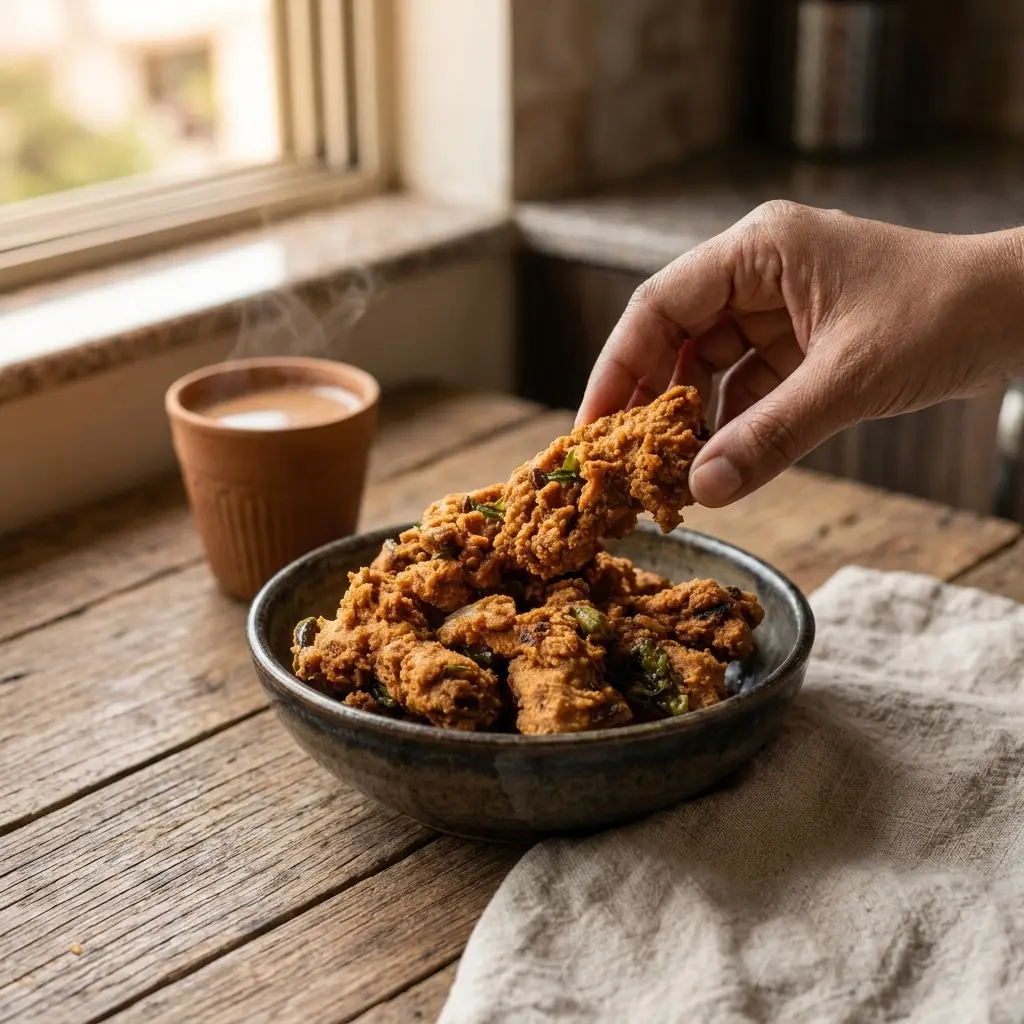
The iconic Vadasery Cashew Onion Pakoda: Thinly sliced caramelized onions studded with whole cashews and fennel.
The 4 Culinary Secrets That Separate Crunch from Sponge
Secret 1: The 'Zero-Water' Dry Binding Principle
The single biggest mistake amateur cooks make is adding water to create a batter. In our Vadasery kitchen, water never touches the pakoda bowl. Instead, we use the osmotic power of salt:
- Thinly slice firm pink country onions (chinna vengayam or small red onions).
- Massage the sliced onions vigorously with sea salt, crushed ginger, green chilies, and torn curry leaves.
- Allow the mixture to rest for 5 to 7 minutes. The salt draws out the onion's natural cellular juices, creating a glistening moist base.
- Sprinkle coarse gram flour (besan) and fine rice flour over the onions in batches, tossing lightly until the flour merely dusts and coats the onion ribbons like wet sand. There should be zero liquid pooling at the base.
Secret 2: The Rice Flour & Hot Oil Scalding (Moyan)
Gram flour alone has a high protein content that can develop a chewy, bready texture when cooked with moisture. To counteract this, we introduce two critical textural agents:
- Aged Rice Flour (Arisi Maavu): Adding 25% to 30% fine raw rice flour introduces high-amylose starch that forms an impenetrable, brittle glassy glaze around every onion strand during frying.
- Scalding Hot Groundnut Oil: Before dropping the pakoda into the cauldron, we take 2 to 3 tablespoons of smoking-hot frying oil from the kadai and pour it directly over the dry-floured onion mixture (a technique known as Kaacha Ennai or Moyan). This instantly gelatinizes surface starches, ensuring an impossibly crisp, flaky bite.
Secret 3: The Aromatic Trinity of South Tamil Nadu
What gives Vadasery pakoda its distinct flavor that sets it apart from Madurai or Chennai street pakoda? It is our signature aromatic blend:
- Coarsely Crushed Fennel Seeds (Sombu): Never powdered. Coarsely bruised whole fennel seeds burst open in hot oil, releasing sweet anise-like essential oils that cut cleanly through the rich onion sugars.
- Whole & Halved Cashews (Mundhiri): Generous handfulls of raw Western Ghats cashews are mixed into the dough. As they fry alongside the onions, they turn buttery, nutty, and golden brown.
- Asafoetida (Kootu Perungayam): Pungent rock asafoetida dissolved in minimal warm water provides deep umami and digestive balance.
Secret 4: Frying Kinetics in Cold-Pressed Groundnut Oil
You cannot achieve genuine Vadasery crunch with refined industrial palm oil. Palm oil saturates the onion ribbons, breaks down into greasy polar compounds at high heat, and softens rapidly at room temperature.
At RajaGopal Sweet Stall, we fry exclusively in heavy cast-iron urulis filled with pure cold-pressed groundnut oil. Groundnut oil maintains an even 185°C to 190°C frying temperature, creating a rapid thermal shock when the loosely scattered onion shreds hit the oil. The exterior dehydrates in seconds, trapping natural sweetness inside while sealing out grease.
| Feature | South Indian Onion Pakoda (Vadasery Style) | North Indian Onion Pakora / Bhaji |
|---|---|---|
| Batter Consistency | Zero added water; dry crumbly coating clinging to onions | Pourable, liquid besan batter coating vegetables |
| Interior Texture | 100% crispy, brittle, and caramelized throughout | Soft, spongy, bread-like cake interior |
| Signature Spices | Crushed Fennel (Sombu), Fresh Curry Leaves, Cashews, Hing | Ajwain, Carom seeds, Garam Masala, Kasuri Methi |
| Dropping Technique | Scattered loosely with fingers in irregular shreds | Spoonfuls or round balls dropped into oil |
| Crunch Longevity | Remains crisp for 5 to 10 days when moisture-free | Must be eaten hot; softens within 30 to 60 minutes |
How Street Vendors Ruin Pakoda vs. How to Master It at Home
When analyzing why street corner pakodas often disappoint, three fatal shortcuts become apparent:
- Using Baking Soda: Many cooks add baking soda thinking it improves crispiness. In reality, baking soda acts as a chemical leavener that aerates the batter, causing it to soak up excessive frying oil like a sponge. Authentic Vadasery Pakoda contains zero baking soda.
- Overcrowding the Kadai: Dropping too much pakoda at once plummets the oil temperature. When the oil drops below 160°C, the onions stew in lukewarm fat instead of flash-frying, resulting in grease-logged savouries.
- Trapping Steam in Packaging: Storing warm pakoda in airtight boxes or polythene bags immediately turns trapped steam into surface condensation. Always cool freshly fried pakoda completely on stainless steel mesh racks before packing.
The Geometry of the Onion Slice: Longitudinal Cuts vs. Crosswise Rings
Few home cooks realize that knife work directly impacts the crunch dynamics of pakoda. Slicing onions across the equator cuts across the cellular grain, rupturing cell walls and releasing excessive liquid prematurely, which makes your dough soggy. In contrast, authentic Vadasery pakoda requires slicing onions pole-to-pole (longitudinally) into long, thin feathered juliennes. This keeps the cellular fiber intact, allowing the onions to retain structural firmness while their outer surfaces fry into crisp golden ribbons.
How to Store & Revive Freshness for Days
Because authentic Vadasery Cashew Pakoda is fried until steam evaporation is 100% complete, it naturally resists staling. To keep your pakoda crisp for up to 10 days at home:
- Store in Stainless Steel or Glass: Place cooled pakoda in a clean, dry airtight container lined with butter paper. Avoid plastic pouches that retain static humidity.
- The Quick Air-Fryer or Oven Crisp Trick: If humidity softens your pakoda over time, never microwave it. Instead, spread the pakoda on a baking tray and warm in a preheated oven or air-fryer at 160°C (320°F) for 3 to 4 minutes. The groundnut oil within the starch matrix re-activates, restoring its day-one shattering crunch.
The Sacred 4:00 PM Ritual on Asambu Road
In Nagercoil, time is measured not just by the chiming of church bells or temple gongs, but by the smell of hot pakoda hitting the display counters of Vadasery. Workers returning from government offices, college students, and travelers heading toward Kanyakumari make a mandatory detour to RajaGopal Sweet Stall for a steaming paper cone of Cashew Onion Pakoda paired with our famous Saffron Jalebi or warm Ghee Wheat Halwa.
The contrast between the intense salty, spicy crunch of cashew pakoda and the melting sweetness of pure ghee halwa is considered the ultimate gastronomic pairing of South Tamil Nadu.
Explore More Related Guides & Specialties
- How Vadasery Pakoda Is Made: Step-by-step masterclass inside our morning preparation.
- Pakoda in Nagercoil: The history of tea-time savouries across Kanyakumari district.
- South Indian Murukku Varieties Guide: Kai Murukku, Thenkuzhal, and butter savouries.
- Top 5 Traditional South Indian Crispy Snacks: The ultimate buyer's directory.
- Nagercoil Evening Tiffin Culture: Filter coffee, vadai, and 4 PM community life.
Taste the Real 4:00 PM Vadasery Cashew Onion Pakoda
Experience the legendary crackling crunch of authentic Vadasery Pakoda prepared fresh daily at RajaGopal Sweet Stall on Asambu Road, Nagercoil. Handcrafted in pure cold-pressed groundnut oil with zero artificial additives.