Quick Answer: How Is Mysore Pak Made?
Mysore pak is made from just gram flour, sugar and cow ghee. The besan is roasted, sugar is boiled to a one-string syrup, the flour is stirred in, and hot ghee is added ladle by ladle until the mixture foams and leaves the pan. It is poured into a greased tray and cut while warm. The foaming ghee creates the honeycomb pores. It keeps 7 to 10 days airtight.
Mysore pak looks simple: three ingredients and a pan. In practice it is one of the least forgiving sweets in South India, and the difference between a piece that dissolves on the tongue and one that feels like a brick is decided at the stove, in a few busy minutes. If you want to see the finished sweet first, our ghee Mysore pak page has the price and ordering details. This guide is about the how and the why.
It sits alongside the process stories we have already written for Vadasery pakoda and Nendran banana chips. Where those are fried snacks, Mysore pak is a cooked sweet, so the whole story turns on sugar syrup, ghee temperature and timing.
Where Mysore Pak Comes From: Mysore Palace Kitchens
The most repeated account credits Kakasura Madappa, a cook in the royal kitchens of Mysore Palace, who stirred gram flour, sugar and ghee together when the Maharaja needed a sweet course at short notice. It is usually placed in the reign of Krishnaraja Wodeyar IV in the early twentieth century, with some writers pointing to the 1930s. Food writers disagree on the exact year and on who named it, so treat the date as tradition, not record. What every version agrees on is the palace origin, the "pak" (the sugar-syrup stage) in the name, and that the ruler liked it enough that it reached the shops outside the palace gates.
From there it travelled with Tamil and Kannada families across the south. Today the sweet has two broad styles, a soft and porous one rich in ghee and a harder, denser one. Nagercoil, with its Travancore-Tamil sweet tradition, leans firmly to the first, as we explain below. For the wider picture of what Kanyakumari district makes, see our guide to traditional sweets of Kanyakumari.
Mysore Pak Ingredients and Ratios: Three Items, Zero Room for Error
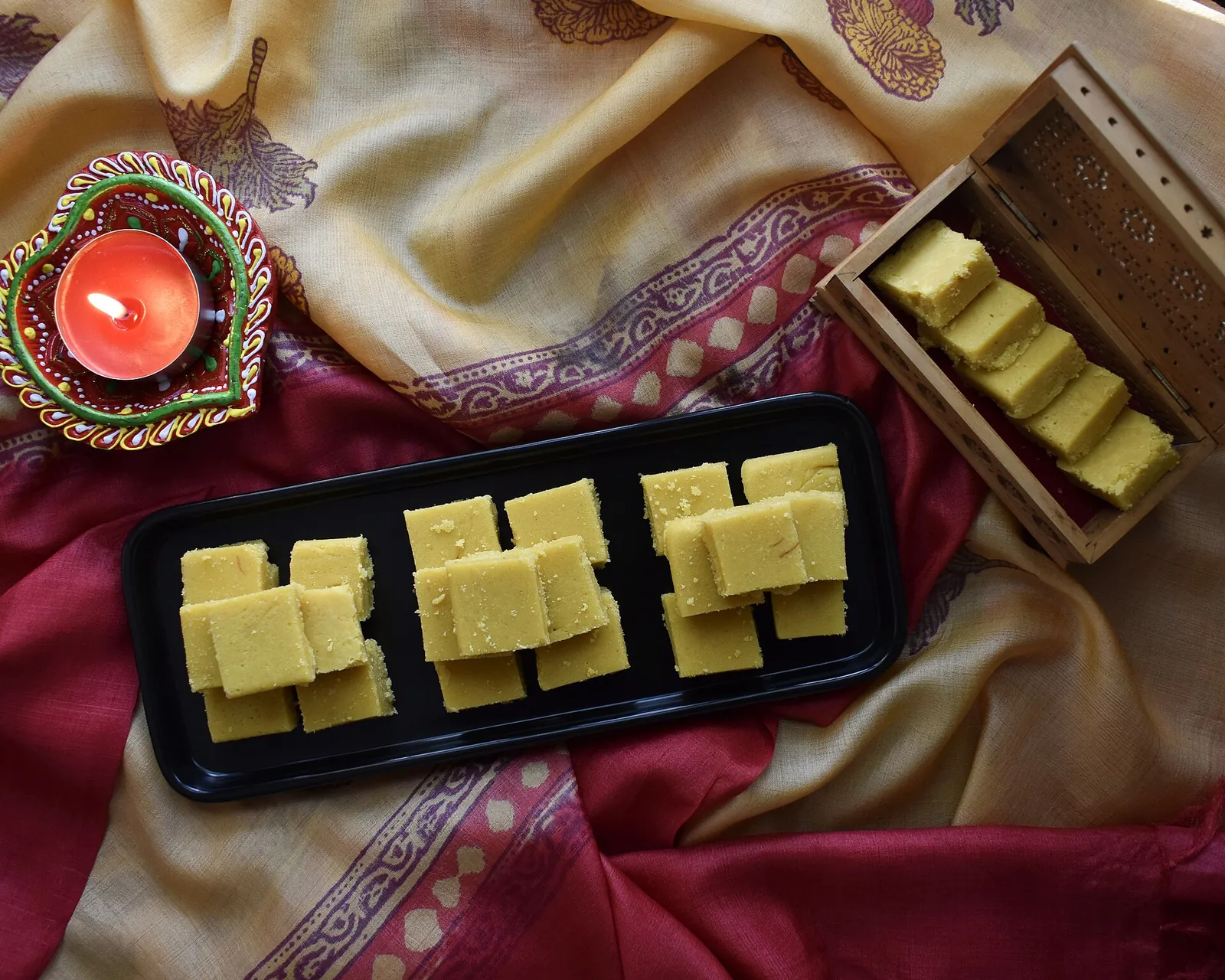
Mysore pak ingredients are gram flour, sugar and ghee. That is the whole list. The proportions below are the typical ones food writers and home cooks use for the ghee-heavy porous style; every halwai adjusts them to the weather and the flour. They are not our shop's secret formula, just the honest ballpark.
| Ingredient | Typical ratio (by volume) | What it does |
|---|---|---|
| Gram flour (besan) | 1 part | Gives the sweet its body and nutty, toasted flavour once roasted |
| Sugar | 1 to 2 parts (about 2 in the classic version) | Becomes the syrup that binds the flour; sets the sweetness and hardness |
| Cow ghee | 1.5 to 2 parts (about 2 in the ghee-heavy version) | Carries aroma, makes the batter foam and leaves the pores that melt on the tongue |
| Cardamom (optional) | A pinch | Home kitchens add it; many Mysore shops leave it out to let the ghee speak |
Notice that there is no water in the batter, no baking soda, no milk and no colouring. Every bit of lift and every pore comes from the ghee and the steam escaping from the syrup. That is why the quality of each of the three ingredients shows so nakedly in the finished piece. For our own counter we use only pure cow ghee and no preservatives or artificial colour, which is the same rule we apply to our wheat halwa, ghee laddu and saffron jalebi.
How Mysore Pak Is Made: Step by Step
Step 1: Sift and roast the gram flour
Fresh gram flour (besan) is sifted twice to break up lumps and then roasted in a little ghee on low heat, stirring until it smells nutty and turns a shade deeper, usually 4 to 5 minutes. This removes the raw, beany taste and makes the flour less likely to form clumps when the hot ghee goes in. Skip it and the sweet tastes of uncooked flour no matter how much ghee you use.
Step 2: Melt the cow ghee and keep it hot
In a second vessel the ghee is melted and held hot but not smoking. It will be added in ladles, so it needs to stay fluid. Because ghee is about as much of the recipe as the sugar, a good halwai tastes it first: ghee that has even a hint of staleness will announce itself in the final sweet.
Step 3: Cook the sugar to a one-string syrup
Sugar is dissolved in water in a heavy pan and boiled until it reaches one-string consistency. To test it, take a drop between thumb and forefinger, pull them apart and look for a single thread. Too thin and the sweet will be soft and weepy and will not set. Too thick, and it turns hard and crystalline. Most failed batches go wrong here, not at the flour stage.
Step 4: Add the flour to the syrup, lump-free
With the syrup at a steady boil, the roasted flour goes in gradually while one person stirs continuously. Adding the flour in a thin stream rather than all at once is what keeps lumps out. The mixture becomes a thick, pale paste.
Step 5: Add hot ghee ladle by ladle (the foaming moment)
Now comes the part people come to watch. Hot ghee is added one ladle at a time. After each ladle the mixture seizes up, then loosens, then starts to bubble and foam as the ghee and the steam escape from the syrup. This is where the honeycomb forms. The stirring is vigorous and unbroken, and the batter changes from paste to a frothy, glossy, golden mass that lifts away from the sides of the pan.
Every standard account of the method describes the same pattern: syrup to a precise stage, roasted flour, hot ghee, constant stirring until the mixture pulls away from the pan. The fat balance matters too. Mixing in oil makes the sweet harder and porous in a brittle way, while an excess of ghee can fill the pores and make it dense, so the ghee-heavy style is a balancing act, not a free-for-all.
Step 6: Pour into a greased tray and let it settle
The moment the batter turns frothy and starts to leave the pan, it is poured into a tray greased with ghee. Timing matters: too early and it will not set, too late and it hardens in the pan before it reaches the tray. The surface is levelled quickly with a spatula and the tray is left alone. As it cools the foam holds its shape and the pores are locked in.
Step 7: Cut while still warm
The block is marked and cut into squares or rectangles while it is warm, usually within a few minutes of setting. Wait until it is fully cold and the knife will crack the sweet instead of slicing it. Cut at the right moment, you get clean edges and a fine, even grain.
Order Ghee Mysore Pak from Nagercoil
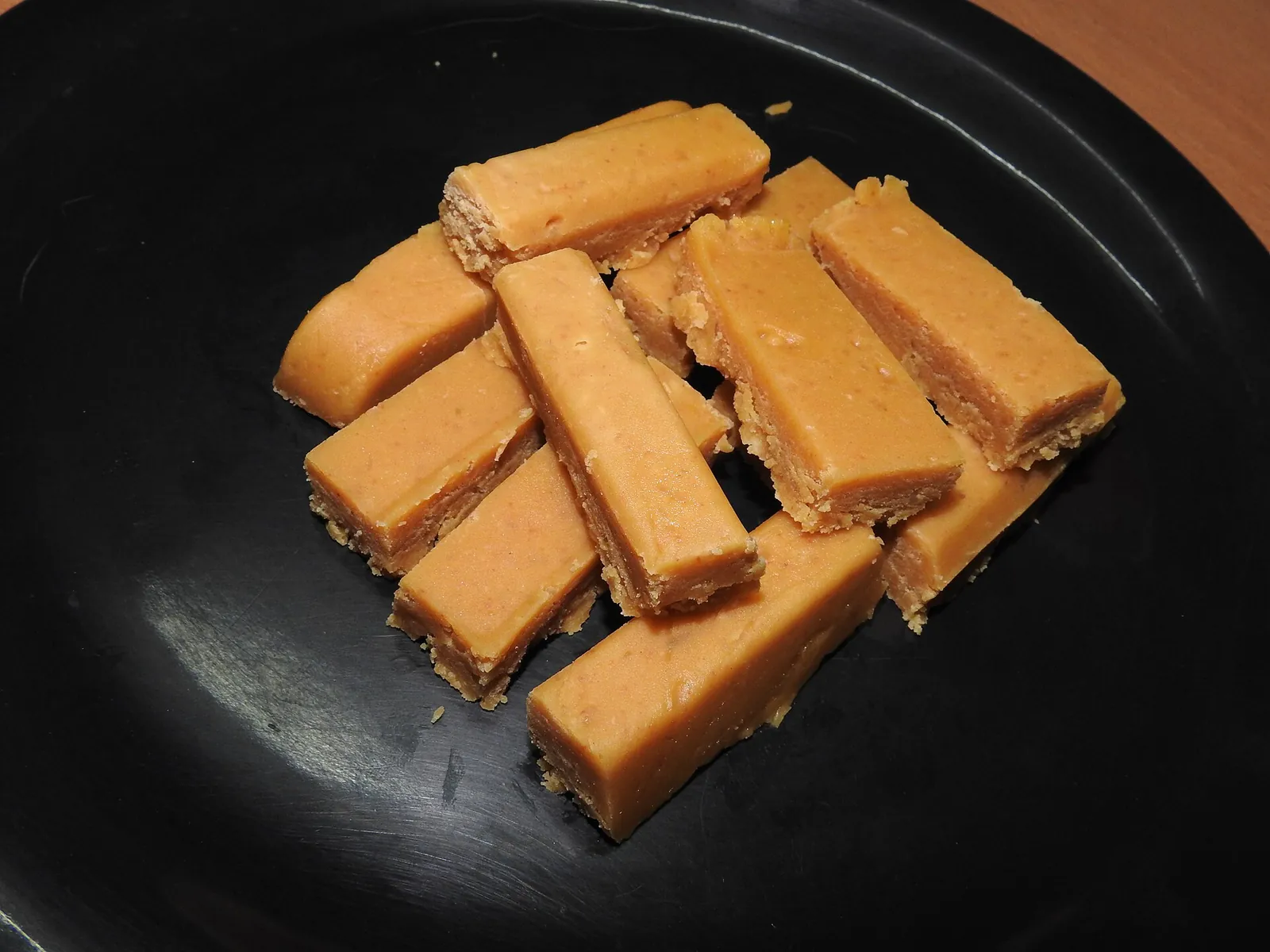
Want it from the counter that sells it, not from a photograph? Our ghee Mysore pak is made with pure cow ghee and no preservatives or artificial colour, and we ship vacuum-packed across India. Bulk and wedding orders need 24 to 48 hours of notice.

Why Cow Ghee Matters: Ghee vs Dalda (Vanaspati) Mysore Pak
Ghee is not just the fat in Mysore pak; it is the flavour and the structure. Pure cow ghee has a low melting point, close to body temperature, and that is exactly why a good piece seems to vanish in the mouth. Vanaspati (often sold under the brand name Dalda) melts at a higher temperature, so it leaves a waxy film on the palate and a flat aroma that no cardamom can hide.
- Texture: ghee foams richly and builds fine pores; vanaspati gives a heavier, closer crumb.
- Aroma: roasted ghee has a caramel-nutty fragrance that is the entire reason people buy the sweet.
- Melt: cow ghee dissolves; vanaspati coats.
- Cost: ghee is the dearest ingredient, which is why cheap Mysore pak is almost never the ghee kind.
If a shop sells Mysore pak at the price of a plain biscuit, ask what fat it is made with. Ours is ghee, which is also why the price on the sweets page is what it is.
Soft vs Hard Mysore Pak and Porous Mysore Pak: Which Does Nagercoil Prefer?
People search for "soft vs hard Mysore pak" because both are sold under one name and they are really two different sweets.
| Feature | Soft, porous (ghee-heavy) | Hard, dense (oil or vanaspati mixed) |
|---|---|---|
| Fat used | Mostly pure cow ghee | Ghee mixed with refined oil, or vanaspati |
| Texture | Honeycomb pores, crumbles gently, melts | Firm, closer grain, crisp snap |
| Aroma | Strong roasted-ghee fragrance | Lighter, sometimes flat |
| Keeps | About 7 to 10 days airtight | Often a little longer, but tastes waxy |
| Cost to make | Higher: ghee is the main ingredient | Lower |
In Nagercoil and across Kanyakumari district, most families ask for the soft, porous, ghee-rich kind, the one that crumbles gently when pressed and leaves your fingers glistening. It pairs with the district's other ghee sweets, and it is what people mean when they ask for "porous Mysore pak". The harder style is more common in some parts of Karnataka and in packaged commercial boxes, where a firmer block travels better.
How to Judge a Good Piece of Mysore Pak
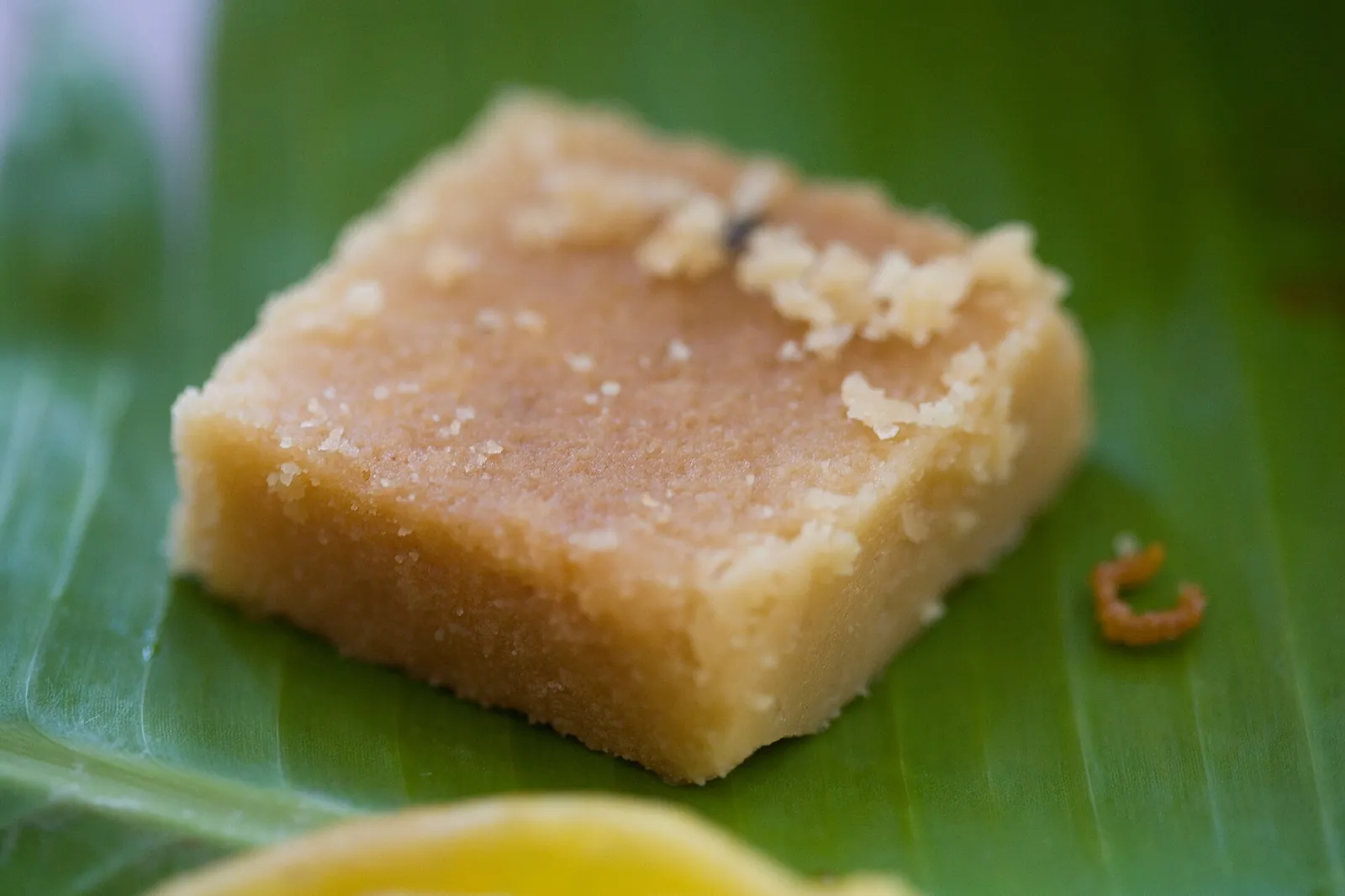
Whether you buy from us or elsewhere, here is the checklist a halwai uses without thinking:
| Check | Good piece | Warning sign |
|---|---|---|
| Surface | Matte, honeycombed, golden-brown | Glossy or sticky with oil |
| Break test | Gives and crumbles softly along the pores | Snaps like toffee or feels gritty |
| Smell | Roasted ghee and gram flour | Stale, rancid or faint vanaspati smell |
| Melt | Dissolves in the mouth in a few seconds | Waxy film left on the palate |
| Colour | Even golden to light brown | Pale yellow (raw flour) or dark brown (burnt) |
One more tip: press the piece gently with a thumb. A good ghee Mysore pak should dent or crumble slightly rather than snap, and the pores should be visible on the cut face, not just the surface.
Mysore Pak Shelf Life and Storage
Mysore pak is a ghee-based sweet with no water in the final mix, so it keeps better than milk sweets, but it is not indefinite. In a clean, dry, airtight steel or glass box at normal room temperature, a ghee Mysore pak stays at its best for about 7 to 10 days. Keep it away from sunlight and from the stove.
- Do not refrigerate by default. Cold sets the ghee firm, and the sweet loses its melt and turns hard. If you must (a very hot week, for example), let it return to room temperature for 30 to 40 minutes before serving.
- Separate it from strong smells. Ghee absorbs aromas easily.
- Use a dry spoon or clean fingers, because moisture is the enemy.
For all our products see the snack and sweet storage and shelf-life guide. If you are carrying it as a gift, the Nagercoil food gifts guide explains how to pack a mixed box. Festival season is when the demand peaks, which we cover in Diwali in Nagercoil, so place bulk orders early.

Mysore Pak Recipe with Ghee: A Home Cook's Quick Reference
If you want to try it yourself, here is the compact version, with the usual warning that your first batch will probably teach you something.
- Roast 1 cup sifted besan in 2 tablespoons ghee for 4 to 5 minutes. Set aside.
- Heat 2 cups ghee in a separate pan and keep it hot.
- Boil 2 cups sugar with 1 cup water to one-string consistency.
- Lower the heat, add the besan in a stream, stirring constantly.
- Add the hot ghee a ladle at a time, stirring vigorously until the mix froths and starts to leave the sides.
- Pour at once into a ghee-greased tray, level, and cut while warm.
Treat these as a starting ratio. Humidity, flour freshness and pan thickness all push the numbers around, which is why our kitchen cooks by eye and smell rather than by cups.
Ghee Mysore Pak in Nagercoil: Photos, Price and Where to Buy
At RajaGopal Sweet Stall on Asambu Road, Vadasery, ghee Mysore pak is priced at ₹180 per 250 g and ₹720 per kg. We have been making sweets here since 1965 (see our story), and the shop is open from 9 AM to 9 PM every day. Order on WhatsApp at +91-9790227409 or write to orders@kumarisnacks.com, and we will pack it vacuum-sealed for travel.

Frequently Asked Questions
How is Mysore pak made?
Mysore pak is made from gram flour, sugar and ghee. The flour is roasted, sugar is boiled to a one-string syrup, the flour is stirred in, and hot ghee is added ladle by ladle until the mixture foams and pulls away from the pan. It is then poured into a greased tray, cut while warm and left to set into a porous block.
What are the ingredients for ghee Mysore pak?
Only three: gram flour (besan), sugar and cow ghee, sometimes with a pinch of cardamom. A typical ghee-heavy porous version uses roughly 1 part besan to 2 parts sugar and about 2 parts ghee by volume, though every maker adjusts the ratio.
Why is my Mysore pak hard and not porous?
Usually the sugar syrup went past one-string stage, the batter cooked too long in the pan, or oil or vanaspati was used in place of ghee. Too little ghee also gives a dense, hard result.
What is the difference between soft and hard Mysore pak?
Soft Mysore pak is ghee-rich with honeycomb pores and a melt-in-the-mouth crumb. Hard Mysore pak uses less ghee or a ghee-oil mix and has a firmer, snappier bite. Nagercoil and Kanyakumari families generally prefer the soft porous style.
How long does Mysore pak last?
About 7 to 10 days in an airtight container at room temperature. Avoid refrigerating it, as cold makes the ghee set and the sweet turns hard.
Who invented Mysore pak?
Tradition credits Kakasura Madappa, a cook in the Mysore Palace kitchens, during the reign of Krishnaraja Wodeyar IV in the early twentieth century. Food writers disagree on the exact year and on the naming story.
Where can I buy ghee Mysore pak in Nagercoil?
At RajaGopal Sweet Stall, Asambu Road, Vadasery, open 9 AM to 9 PM daily. Ghee Mysore pak is priced at ₹180 per 250 g and ₹720 per kg, and can be ordered on WhatsApp at +91-9790227409 for shipping across India.
Header photo: Vaidehi Pujary via Wikimedia Commons, CC BY-SA 4.0.